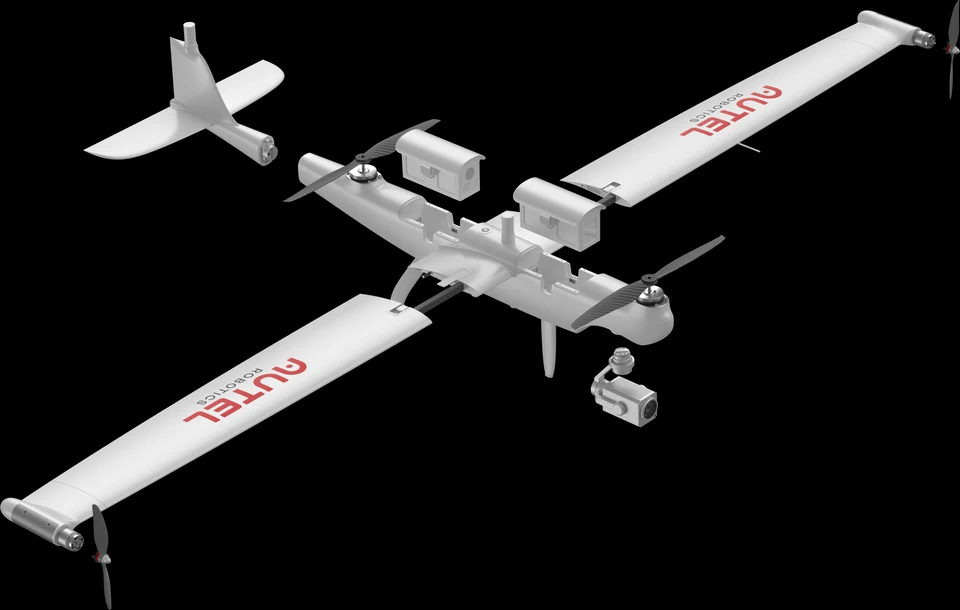
Why Dragonfish endurance figures differ: model, payload and mission reserve
Search for Autel Dragonfish flight time and you can encounter several answers. Older specifications, newer one-sheets and different payload configurations are often displayed together without enough context. Choosing the largest number is an unreliable way to plan a system.
SkyFlow’s Dragonfish pages identify the source configuration alongside the endurance figure. The comparison is based on official material checked October 16, 2026. We have not carried out an equal-condition endurance test of these aircraft.
Start with the exact document and aircraft version
Autel’s supplied newer series one-sheet, created in July 2025, specifies Standard and Pro. It lists 106 minutes for Standard with DG-L20T and 179 minutes for Pro with DG-L20T. It also gives aircraft weights and maximum extra payload figures that differ from some earlier manuals.
For example, an earlier Standard manual gives a 7.5 kg aircraft weight excluding the gimbal and a maximum payload of 1.5 kg. The newer supplied sheet lists 7.7 kg including batteries and propellers, excluding the gimbal, and 1.3 kg maximum extra payload. Those values should not be silently mixed into a more attractive composite specification.
A quotation should identify the actual aircraft generation and the documentation that governs it. If a supplier quotes a different endurance or weight, ask which aircraft, battery, payload and test condition produce that figure. A difference can be legitimate; it still needs an explanation.
Keep Dragonfish-25’s loaded and other figures separate
The supplied Dragonfish-25 one-sheet lists up to 210 minutes with payload. Its aircraft manual describes a maximum endurance of up to 240 minutes in the introductory aircraft description. The page should not combine the 240-minute number with the largest payload value and imply that both are achieved together.
The same principle applies to distance, speed and payload. Maximum values often describe different conditions. You cannot assume the largest speed, longest endurance and largest load form one achievable mission profile.
Dragonfish-25 also belongs to a different aircraft scale: its manual describes a 29 kg aircraft excluding the gimbal. That is a procurement and operating distinction, not just another column in a camera comparison table.
Fixed-wing endurance is not hover endurance
Dragonfish uses vertical flight for departure and recovery, then fixed-wing cruise for efficient travel. A long cruise endurance number does not promise the same duration in a stationary hover.
When comparing a DJI Matrice or Autel Alpha, first identify whether the work requires a moving observation pattern or a camera held near one point. A multirotor’s hover capability can be more important than a fixed-wing aircraft’s longer cruise endurance for a stationary inspection task.
A meaningful comparison states the payload, flight pattern and endpoint. DJI, for example, publishes separate Matrice 400 flight and hover figures with stated conditions. Neither should be used as a casual percentage-performance comparison against a different Dragonfish test.
Turn a manufacturer maximum into a planning question
Ask what useful time is required over the work area after launch, transition and transit. Then account for return, recovery, reserve, weather and contingency. The answer needs an approved operating procedure and appropriate evidence; a marketing maximum alone cannot supply it.
Route geometry matters as well. Turns, terrain changes and the location of a suitable recovery area affect how an aircraft performs a particular job. A long straight corridor, a search pattern and close stationary inspection are different missions even when their map areas look similar.
For procurement, request a documented acceptance method that reflects the actual payload and operating pattern. Define the data to be collected and the conditions under which the system must demonstrate the required outcome. Do not demand a test that consumes all reserve simply to reproduce an advertised maximum.
Range is another condition, not permission
Dragonfish materials also vary in published transmission figures across versions and ground-system arrangements. Base stations, antennas, interference, terrain and regulatory radio configuration can affect the link. A quoted maximum does not establish the usable radius at your site.
More importantly, a functioning radio link does not authorize a Canadian flight. Check Transport Canada’s current operating requirements for the actual aircraft and mission. Automation, RTK and a long transmission specification do not establish an aircraft declaration or BVLOS approval.
What SkyFlow needs to prepare your quotation
Share the proposed route or area, required camera information, operating location, mission frequency and deployment pattern. Identify whether you are buying a new system or expanding an existing Dragonfish fleet, because compatibility and support can depend on generation.
We will scope the aircraft, compatible payload, controller, ground communications equipment, battery inventory and services in writing. The supplied photographs and videos explain the family; they are not packing lists. Begin with the Standard, Pro and Dragonfish-25 comparison, then request the configuration that fits your work.
Sources
Configure a Dragonfish system with SkyFlow.
Share your route, camera requirements and deployment pattern. SkyFlow is an Autel Authorized Dealer; aircraft, payload, ground system, contents and availability are confirmed in your quotation.